
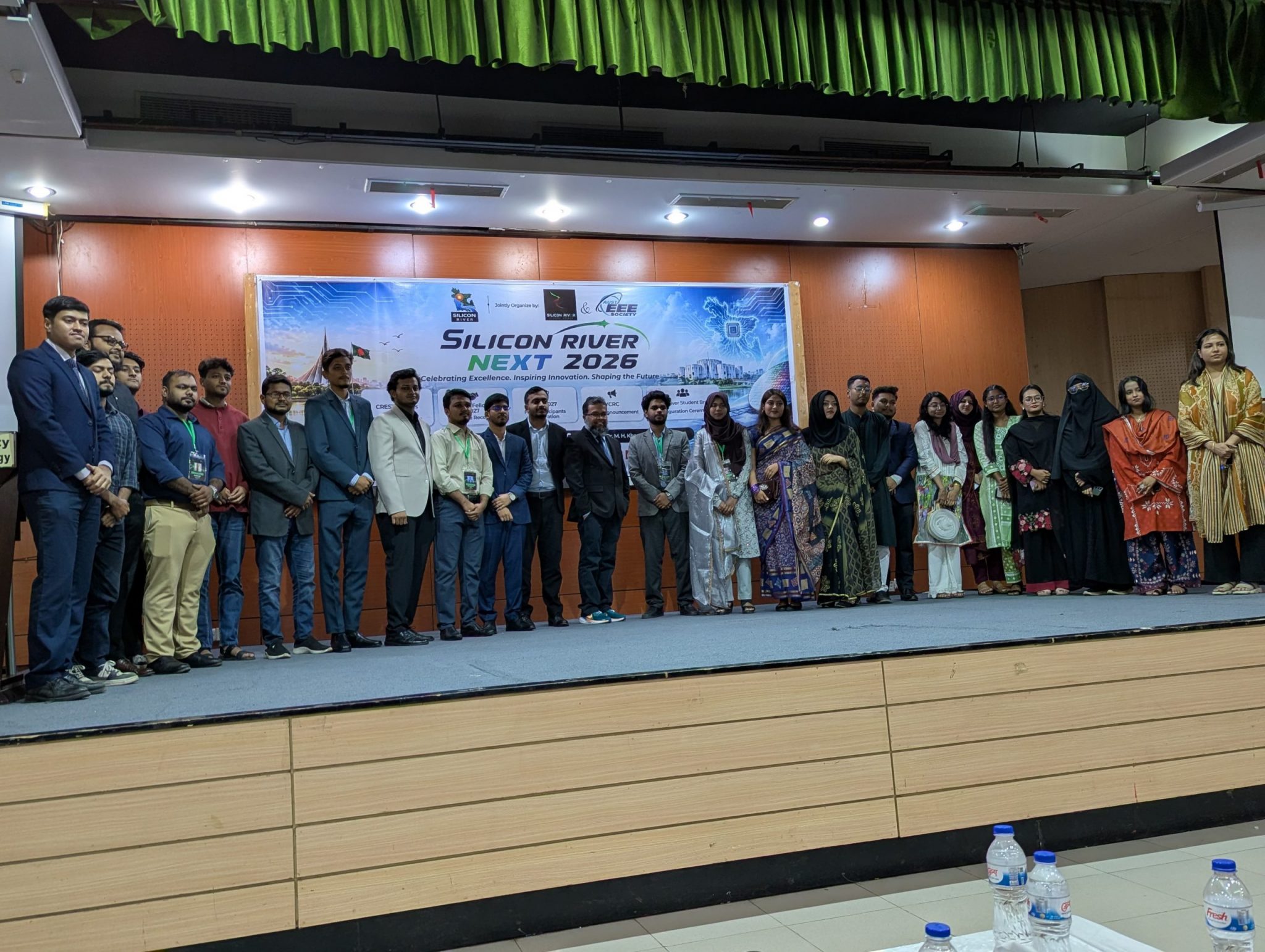
Silicon River NEXT 2026 was held today at 10:00 AM at Ahsanullah University of Science and Technology (AUST), Dhaka. The event brought together government, industry, academia and student innovators to highlight progress in semiconductor research, employment, innovation and commercialization.
Chief Guest was Md. Anwar Hossain, Secretary, Ministry of Science and Technology. Special Guest was M. A. Jabbar, BSIA President and Managing Director of Neural Semiconductor Limited. Participants included the AUST Vice Chancellor, academics, industry representatives, and Professor Muhammad Mustafa Hussain, Professor of Electrical and Computer Engineering at Purdue University, USA, and Chief Architect of Silicon River Bangladesh.
CREST: Research to Global Engineering Careers
Ten CREST 2026 fellows were recognized. For CREST 2027, 18 researchers across 11 projects from ten universities were selected for BDT 2.46 million in support: BUET, University of Dhaka, BRAC University, AIUB, IUT, AUST, North South University, RUET, University of Chittagong and IIUC. Supported by Neural Semiconductor, their research covers advanced memory, agentic AI, 3D integration, RISC-V, quantum electronics and photonics.
GlobalFoundries has scheduled on-site interviews in Dhaka on November 15 for CREST 2026 fellows, aimed at direct recruitment into regular full-time engineering roles. Offers remain subject to its recruitment process.
CES 2027: Sixteen Innovations for the World Stage
Sixteen innovations from 13 academic institutions were selected for the Bangladesh Innovates Pavilion at CES 2027, January 6–9 in Las Vegas: ten hardware and six software/AI solutions. Represented institutions are BUET, University of Dhaka, KUET, CUET, AIUB, IIUC, UIU, MIST, North South University, Daffodil International University, Eastern University, BAIUST and Aalborg University, Denmark.
Projects span healthcare devices, bionics, assistive technologies, agricultural drones, solar cleaning robotics, smart grids and AI. The goal is to connect promising products to international customers, investors and industrial partners.
YCRC: A Five-Institution Research Consortium
The first YES Collaborative Research Center (YCRC), supported by US semiconductor equipment company Yield Engineering Systems (YES), will be led by the University of Dhaka Semiconductor Technology Research Centre (STRC), with BAEC, BRAC University, Islamic University Kushtia and Delft University of Technology (TU Delft), Netherlands.
The YES-G1000 plasma processing platform will support semiconductor processing, packaging, device research and digital twin development. Equipment dispatch is targeted by December 31, 2026. The consortium will cover shipment, installation and operating costs.
Student Branch and Measurable Progress
The Silicon River Student Branch (SR-SB) network now spans more than 60 universities. AUST students and alumni, together with SR-SB volunteers, contributed to the event.
The vFabLab has surpassed 6,100 users. Progress continues on the BUET STAR facility, BAEC laboratory revival, SICIP workforce training targeting 3,500 trainees, and international industrial partnerships.
What Comes Next
Upcoming goals include a GlobalFoundries Advanced Design Kit (ADK) initiative in 2027, an OSAT joint venture by 2028, a 180-nm MEMS fabrication facility by 2029, and a proposed USD 14 million Digital Twin and Test Hub.
The broader ambition is to move Bangladesh from primarily consuming imported technologies toward producing globally valuable research, intellectual property, products and engineering talent.